

Chemical Anchor: When Concrete and Steel Become One
A properly installed chemical anchor will pull the concrete before it shifts itself. This is not a way to 'screw' — it is a way to make steel and concrete one material.
Solutions for Protecting Heavy Metal Structures and Technological Equipment
Hydromembrane LLC is the official distributor of leading anchoring systems in Ukraine.
Chemical Anchor — a connection that works with the tension of the structure, not against it.
The mechanical anchor presses. It expands the concrete from the inside, holding on due to friction, and always leaves a zone of stress around it — tiny, but alive. Over the years, this tension works against the structure: micro-cracks, vibration, freezing water in the pores. The metal wedge does not merge with the base — it is merely wedged in it.
The chemical anchor acts differently. It does not expand — it connects.
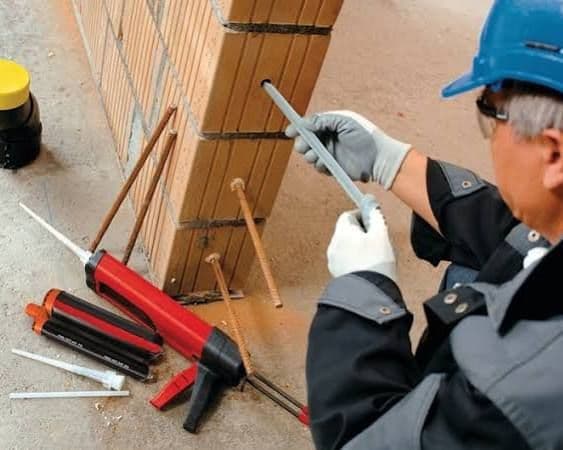
Synthetic resin fills every irregularity of the borehole, envelops the threads of the bolt, and penetrates the capillaries of the concrete. After polymerization, a monolithic joint is formed, where the load is transferred not at a point, but over the entire contact surface. There is no expansion — there is no stress in the body of the concrete. The anchor ceases to be a foreign body and becomes an extension of the structure.
The advantage of chemical fastening over mechanical is that it holds heavy metal structures, facade brackets, fences, technological equipment — and does so for decades, because there is no gap between steel and concrete where water or corrosion could enter.
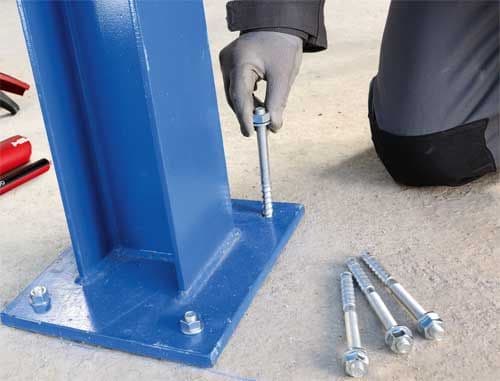
Chemical fastening works where mechanical is powerless: close to the edge of the slab, in dense reinforcement, in brick and hollow blocks, under dynamic and seismic loads.
Contact Form
Need a Consultation?
Our engineers will select the optimal solution for your object